Can Solar Panels Survive UK Winters?
Answer the questions below to start your quote
Winter in the UK can get very cold and overcast.
So, it’s natural for those with solar panels installed to wonder how effective their energy production will be.
Let’s explore whether solar panels work in the UK’s winter.
How solar panels work in Winter
Solar panels don’t need heat to generate electricity—they need light (and they hey have photovoltaic (PV) cells to convert it into energy).
When sunlight hits the cells, it creates an electric field, which produces electricity.
In fact, excessive heat reduces the efficiency of PV cells. And during cooler months, panels operate closer to their optimal temperature range, leading to consistent energy output.
Many solar panel systems are tested to withstand temperatures as low as -25°C. This makes them suitable for even the most challenging UK weather conditions.
British winter
The UK’s national average winter temperature is typically between 3°C and 5°C.
This is relatively mild compared to the rest of Europe, despite its northern latitude. It’s primarily due to its exposure to the Atlantic Ocean and the warming influence of the North Atlantic Drift (the northern extension of the Gulf Stream).
For comparison, Astana in Kazakhstan sits at the same latitude as London but has an average winter temperature of -10°C to -19°C!
The coldest area in the UK is Braemar, in Scotland, where the median winter average is 1°C to 3°C.
Example county: Kent’s winter conditions
Kent – where we are based – is one of the warmest parts of the UK.
Its winters can be relatively mild, with median average temperatures of 4°C to 6°C.
The coldest recoded temperature in Kent was in 1962, when it dropped to -20°C. This caused the sea water by Whitstable on the northern Kent coast to freeze for over two miles out from land!
However, that was a very rare event. Kent winters typically only feature cloudy skies, intermittent rain, and the occasional frosty morning.
Efficiency of Solar Panels in Cold Weather
Solar panel systems don’t need direct sunlight. They can work with daylight even when the sky is overcast.
On a typical winter’s day, Kent still receives around 8-9 hours of daylight. This is more than enough to keep panels generating electricity.
However, the difference lies in quality.
High-end panels excel in low light, while cheaper ones may falter.
Our SunPower solar panels, for example, deliver 60% more energy over 25 years.
(This is backed by performance data from over 35 million solar panels installed worldwide.)
Anyway, solar panel systems operate more efficiently at cooler temperatures.
It’s part of the reasons why some leading solar nations, like Sweden, boast successful solar installations despite their cold climates.
In fact, Germany generates enough solar power to meet 12% of its energy needs despite its grey skies.
How solar performs during specific winter conditions
Overcast skies
Many people fear that cloudy weather makes solar PV systems redundant. But this is wrong.
While production might be lower than on a sunny day, a solar PV system can still work at 10-25% of their maximum capacity.
For context, that’s still enough to power key appliances in your home.
Snow
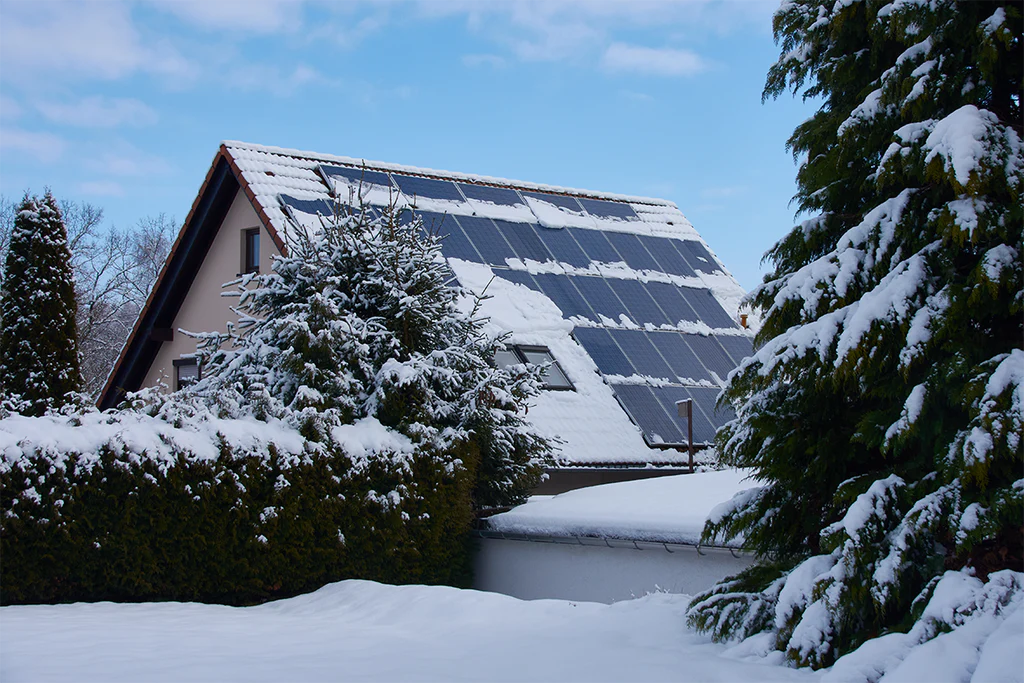
Snow is not a problem for most solar panels, which are installed at an angle that usually causes to slide off. And even solar panels on flat roofs are angled.
In rare circumstances, particularly heavy snow might settle on solar panels. This blocks sunlight from reaching the solar panel (snow reflects sunlight).
Frost
Panels are built from durable materials that resist freezing temperatures without affecting performance. If frost does manage to gather on solar panels, it will block sunlight from reaching them.
Rain
Believe it or not, rain is one of the friendlier conditions for your solar panels.
Output dips a little while the clouds are overhea, but that’s down to the clouds, not the rain.
The rain itself washes away dirt, pollen and debris, and cools your panels down so they work more efficiently once the sun’s back out.
So every drizzle really is a free rinse for your solar system!
Fog
Fog is the real culprit when it comes to reducing winter solar output.
Because it sits close to the ground and scatters sunlight in all directions instead of letting it through directly, thick fog can cut your panels’ output by 30–50%. And by as much as 70% on the densest days.
Unlike rain, it doesn’t come with any silver lining (no cleaning, no cooling). It simply causes diffused light.
The good news: it usually clears by late morning, so your panels bounce back once it lifts.
Battery Storage: Making winter power go further
Shorter days mean less daylight, but that’s where solar battery storage comes in.
The Tesla Powerwall battery stores excess energy generated during sunnier periods, allowing you to use it when production dips.
Its 13.5 kWh storage capacity is typically sufficient to power a standard UK home during the evenings or low-sunlight hours.
This estimate is based on the battery being fully charged and depends on the customer’s energy usage and system generation. (Actual performance may vary based on these factors.)
This system allows solar panels to continue generating power during outages too—which standard setups without batteries cannot do.
Moreover, its time-of-use grid purchasing capability means you can buy energy cheaply during off-peak hours, store it, and use it during high-cost periods.
Pairing solar with EV chargers is especially useful, even in winter.
The longevity and durability of solar panels in winter
Our SunPower Solar PV Panels are backed by extensive third-party testing and comprehensive 40-year warranty coverage.
They’re built to handle a range of conditions, from hailstorms to strong winds. In short, Kent’s mild winters are no match for a good-quality solar system.
What about solar panel maintenance? Panels require minimal upkeep, even in winter.
If snow or debris accumulates, a quick brush-off is usually enough to restore full efficiency.
The robust design ensures your investment continues to pay off year after year, regardless of the season.
Read our guide on the best solar panel batteries for the UK here.
Start Your Solar Journey Today
Ready to harness the power of the sun, even in Kent’s chilliest months? The Little Green Energy Company is here to guide you every step of the way.
Book your free survey today to explore how a solar panel installation can transform your home or business’s renewable energy use.
Whether you’d like to install solar panels, battery storage, or do a general maintenance check, our award-winning team is ready to help you maximise your investment and reduce your carbon footprint.
Let’s create a greener future together.